Printable Seed Starting Chart (Free PDF)

One row per crop, with the two dates that matter — when the seed goes in indoors and when the plant goes out.
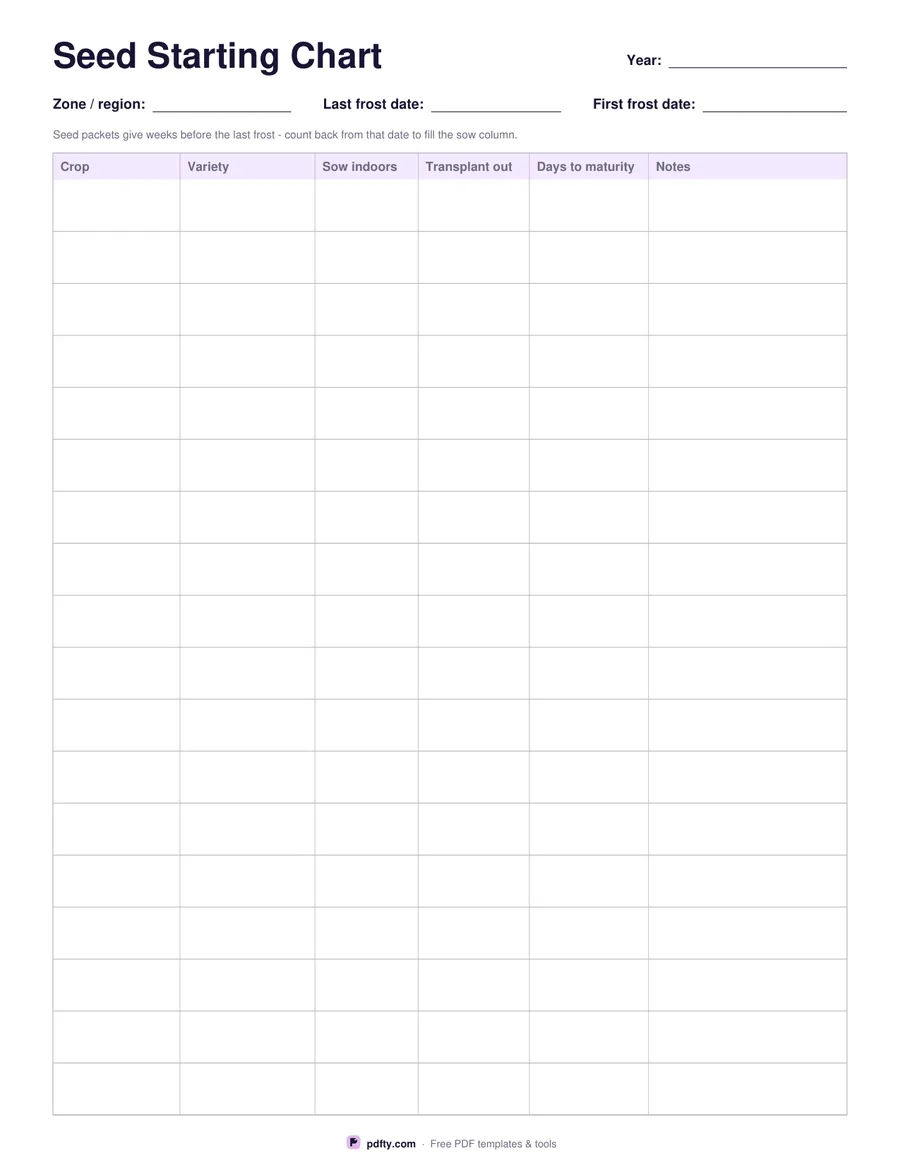
Printable seed starting chart with crop, variety, sowing date, transplant date and days to maturity
Rows
Paper size
Fill & edit free online

Free · no watermark · no sign-up for your first 20 downloads a day

Fillable PDF — type into the fields online or in any PDF viewer before printing.

Seed packets give sowing times as weeks before the last frost, which is useless until you write your own frost date down and count back from it. This chart puts that date at the top, next to your zone or region and the first frost date for the autumn, then gives you a row per crop: the crop, the variety, the date to sow indoors, the date to transplant outside, the days to maturity from the packet, and a notes column for heat mats, soaking or light.

Filling it in is the planning. Work through the seed box one packet at a time, convert each "start 6 to 8 weeks before last frost" into a real date, and the sowing weekends space themselves out instead of landing all at once in March. The days-to-maturity column tells you later whether a crop will finish before the first frost, which decides what is worth sowing in a short season.

Choose 18 roomy rows for handwriting, or 26 tighter rows if you grow a lot from seed. Every cell is a form field, so you can type the chart up, print it for the potting bench, and keep a copy for next year with the notes you made about what germinated and what sulked. One page, US Letter or A4.
How to use it

  1. 1

    Pick the number of rows

    18 rows leave more room to write; 26 rows fit a bigger seed collection. Then choose US Letter or A4.

  2. 2

    Write in your frost dates

    Fill the zone or region, the last frost date and the first frost date at the top — every sowing date on the sheet is counted from them.

  3. 3

    Fill a row per packet

    Copy the crop, the variety and the days to maturity from the packet, then work out the sow and transplant dates.

  4. 4

    Print or fill it in

    Print at 100% ("Actual size") so lines and boxes keep their exact spacing, or fill the form fields on screen in any PDF viewer.

Frequently asked questions

Yes. There is no watermark and no sign-up for your first 20 downloads each day; after that a free account keeps downloads going. You may print the file as often as you like for personal, school or business use.
18 or 26, depending on the option you pick. Print a second sheet if you grow more; the header lines for zone and frost dates repeat on each copy.
Yes. Every cell in the table and every line in the header is a form field, so the chart can be filled on a computer and printed, or printed blank and written on.
Your national or regional extension service, meteorological office or a local garden club publishes average first and last frost dates for your area. Write the dates you use on the sheet so next year's chart starts from the same assumption.
Yes. For crops sown straight into the ground, leave the sow indoors column empty and put the date in the transplant out column, or note it in the notes column.
Yes. Any PDF app that supports forms will let you type and save; printing it and using a pencil survives wet hands better.

More free templates

Work with your PDF