Colour Mixing Chart (Free Printable PDF)

Record the mixes you make: paint the swatch, write the two base colours and how many parts of each, and you can mix the same colour again next week.
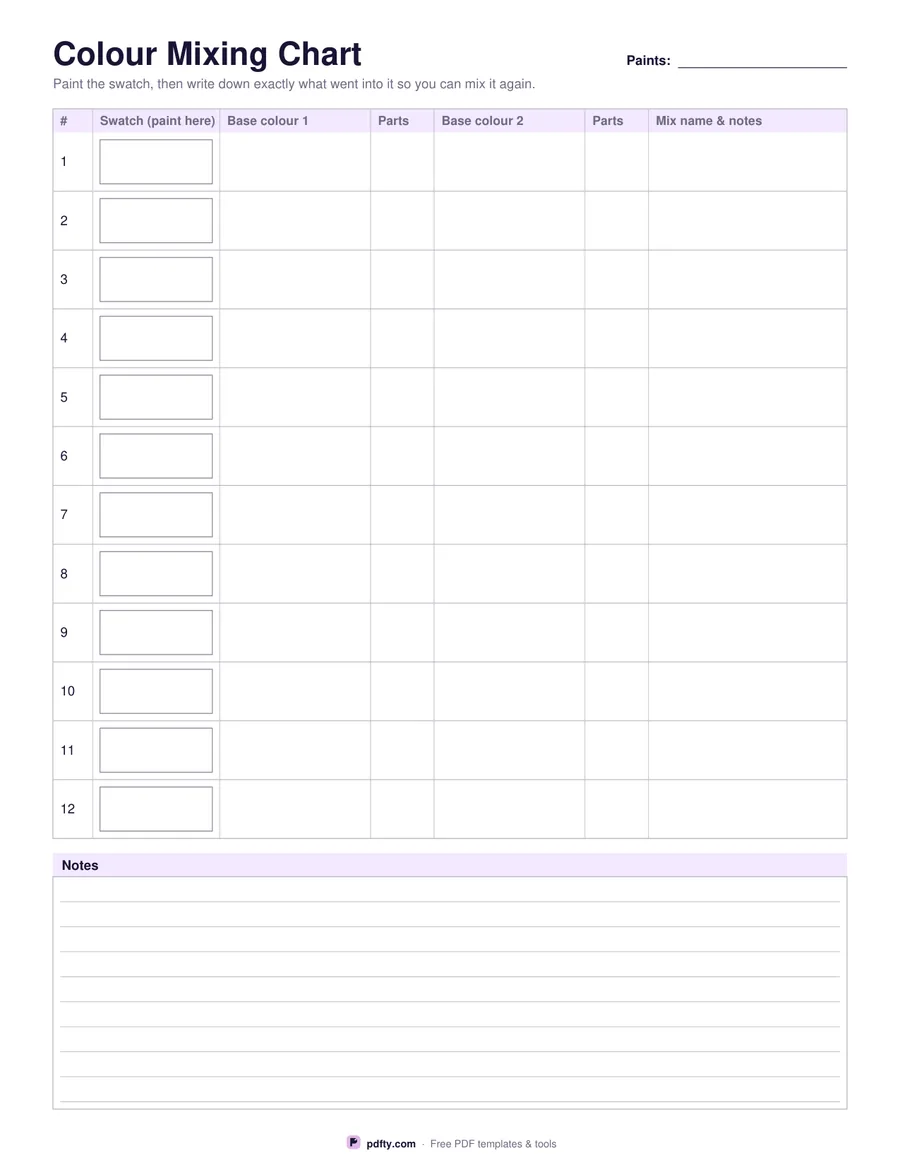
Printable colour mixing chart with swatch boxes and columns for base colours and ratios
Rows
Paper size
Fill & edit free online

Free · no watermark · no sign-up for your first 20 downloads a day

Fillable PDF — type into the fields online or in any PDF viewer before printing.

A mix you cannot repeat is a mix you have lost. Each row of this chart has a numbered swatch box with room to lay down a brushful of the colour you just mixed, then columns for the first base colour and how many parts of it, the second base colour and its parts, and a wider column for the mix name and any notes, such as the medium, the white you added or the paper you tested it on.

Choose twelve rows for large swatches or sixteen for a denser chart; the rows stretch to fill the page in both cases, so a twelve row chart gives each swatch a deep box that shows the colour properly even in a thin wash. There is a line at the top to name the paint set you are working from, because the same two colour names from different brands rarely mix to the same thing.

The chart suits watercolour, gouache, acrylic and oil equally; for wet media print it on the heaviest paper your printer takes, or paint the swatches on scraps and glue them into the boxes. The base colour, parts and notes columns are form fields if you would rather type them after the paint dries. A ruled notes block at the bottom takes observations about the set as a whole, such as which pigments granulate or dry back lighter.
How to use it

  1. 1

    Choose how many mixes per page

    12 rows give each swatch a deep box; 16 fit more mixes on one sheet.

  2. 2

    Print or fill it in

    Print at 100% ("Actual size") so lines and boxes keep their exact spacing, or fill the form fields on screen in any PDF viewer.

  3. 3

    Paint a swatch per row

    Mix the colour, lay a swatch in the box and let it dry fully before judging it, since most paints shift as they dry.

  4. 4

    Write down the recipe

    Record both base colours and the parts of each, plus a name you will recognise later.

Frequently asked questions

Yes. There is no watermark and no sign-up for your first 20 downloads each day; after that a free account keeps downloads going. You may print the file as often as you like for personal, school or business use.
With watercolour or gouache, print on the heaviest paper your printer accepts and keep the washes light. For thick acrylic or oil, paint on scraps and glue them into the swatch boxes.
Twelve or sixteen, depending on the option. Both fill the page, so twelve simply gives each swatch a bigger box.
There are two base colour columns with a parts column each; a third pigment goes in the notes column with its ratio.
Yes. The base colour, parts and notes cells are form fields, so you can print blank sheets, paint them, then type up the recipes.
Yes. Makers use the same chart for glazes, inks, resin tints and dyes, anywhere a ratio and a swatch need to stay together.

More free templates

Work with your PDF